
Ask five neighbors how often they clean their gutters and you’ll probably get five answers, from “every fall” to “when I see water pouring over the edge.” The right answer depends less on the calendar than on what’s growing around your house.
Here’s how to figure out the right schedule for your home in the Philadelphia suburbs, and how to tell when your gutters can’t wait.
How often should gutters be cleaned?
For most homes, twice a year: once in late spring and once in late fall after most of the leaves have come down. That timing catches the two biggest loads of debris our area produces.
Some homes need more. If large trees hang over your roof, three or four cleanings a year is common. Homes with no trees nearby can sometimes stretch to once a year, but they should still be checked after big storms.
Why the trees around your house matter most
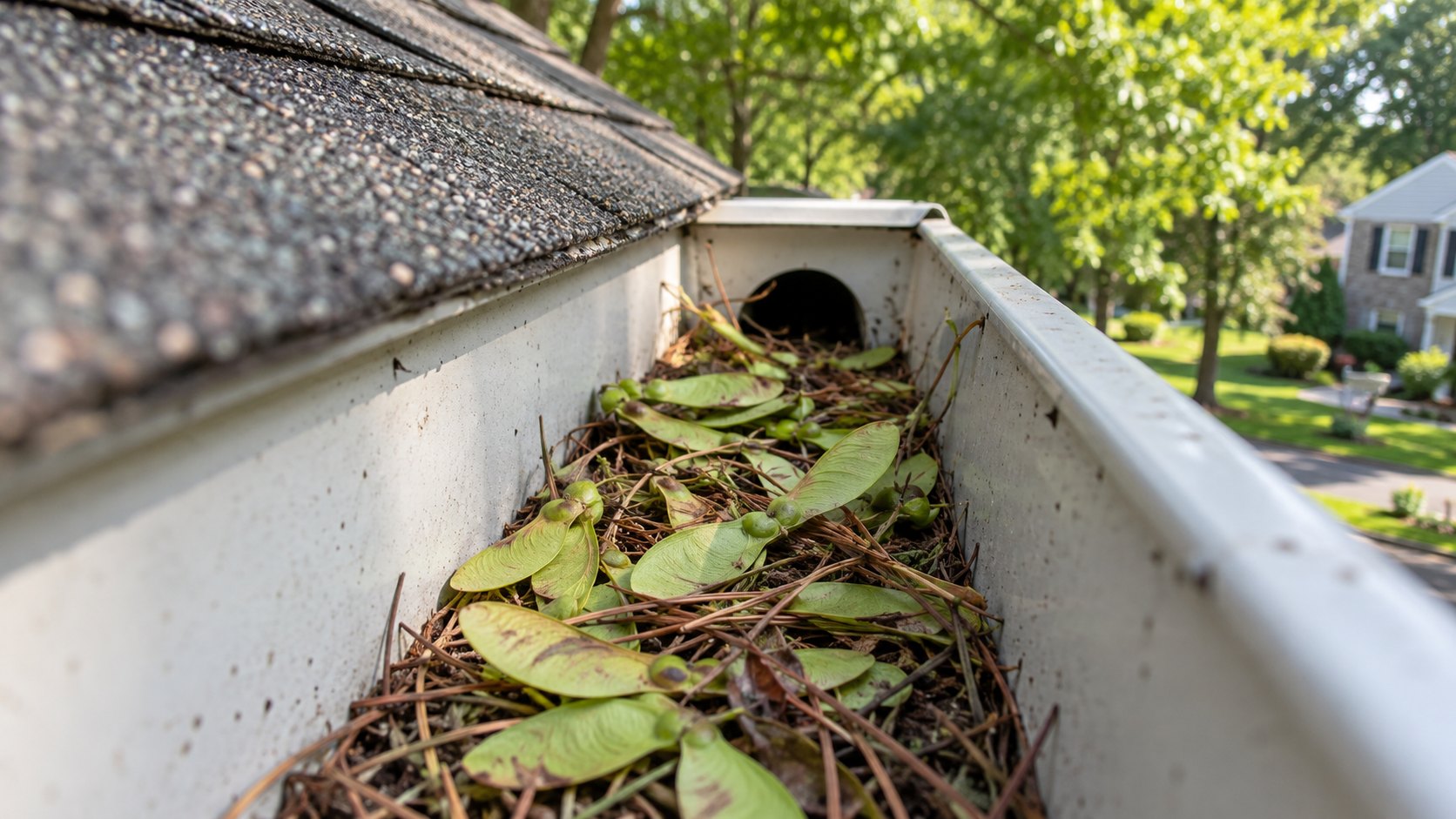
Southeastern Pennsylvania is full of mature trees, and each type fills gutters on its own schedule:
- Maples drop their winged “helicopter” seeds in spring, and those seeds pack tightly into gutters and downspouts.
- Oaks drop acorns in early fall and often hold onto their leaves longer than other trees, so a gutter that looked clear in October can be full again by December.
- Pines and other evergreens shed needles all year. Needles are small enough to slip past many gutter guards and slow enough to drain that they build up quietly.
- Sweetgums drop spiky seed balls that are notorious for plugging the outlet where the downspout connects.
Even without trees, gutters collect shingle grit, windblown debris, and the occasional bird’s nest. Over time that sediment turns into a heavy sludge that holds water and adds weight to the gutter.
Signs your gutters need cleaning now
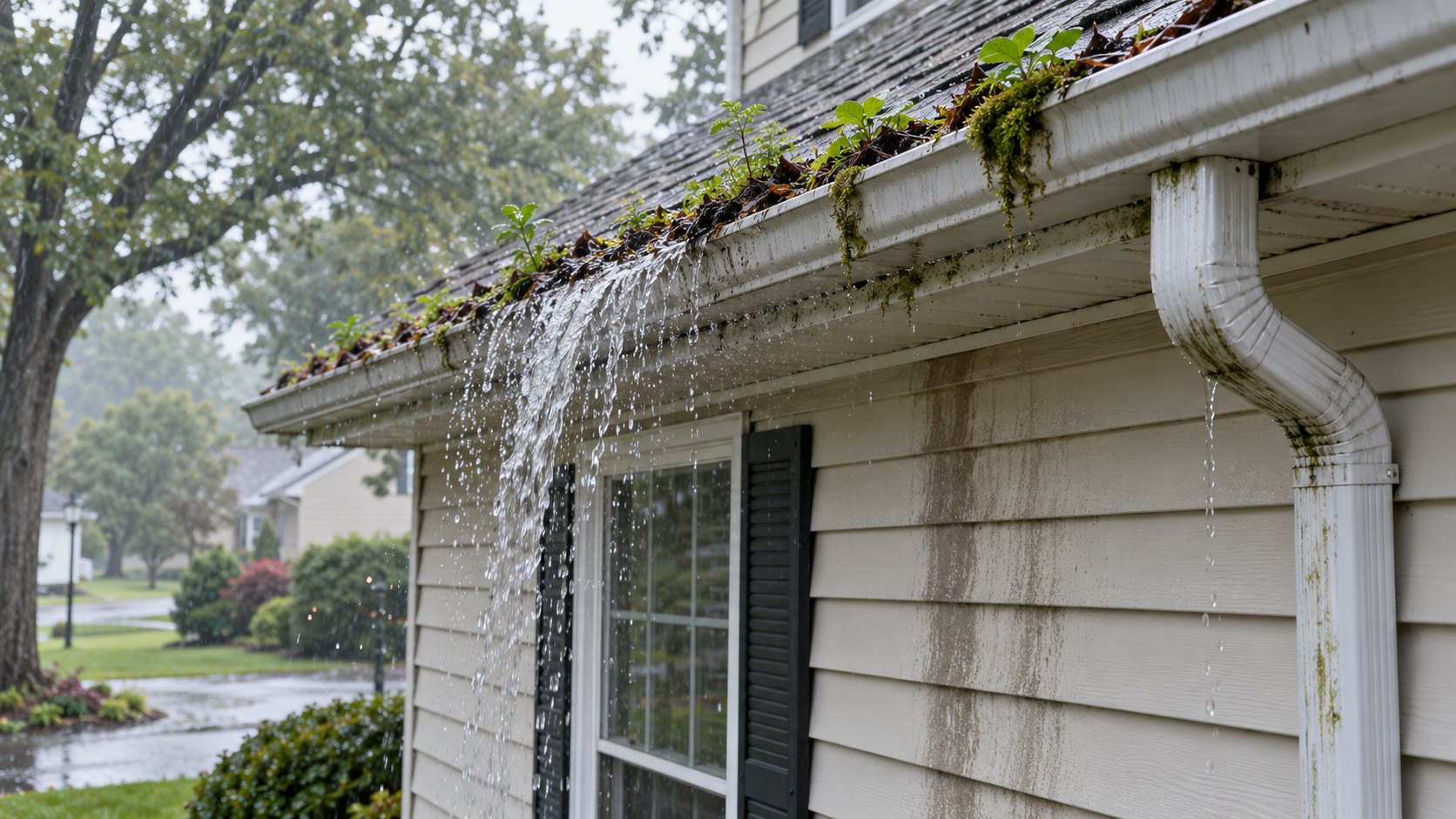
You don’t have to climb a ladder to spot most of these. Walk around the house during or right after a steady rain and look for:
- Water spilling over the edge of the gutter instead of coming out of the downspout
- A downspout that trickles or stays dry while it’s raining
- Plants, moss, or seedlings growing out of the gutter
- Gutters that sag or pull away from the roofline
- Stains or streaks on the siding directly below the gutter
- Washed-out mulch or a small trench in the soil under the roofline
Any one of these means water isn’t leaving your roof the way it should. And that water has to go somewhere. A typical 2,000-square-foot roof sheds about 1,200 gallons in a single inch of rain, and when gutters overflow, much of it ends up against your foundation. Our fall gutter maintenance guide explains what that does to a basement.
Do gutter guards mean you never have to clean them?
No. Guards can reduce how often gutters need attention, but they don’t eliminate it. Pine needles, seed pods, and fine grit still get through or collect on top, and a guard covered in wet leaves can shed water right over the edge the same way a clogged gutter does. Guards also make it harder to see a problem from the ground.
If you have guards, plan on at least a yearly check, and look closely after the heaviest leaf drop.
Is gutter cleaning a DIY job?

On a one-story home with easy ground access, plenty of homeowners handle it themselves. If you do, use a sturdy ladder on level ground, have someone hold it, stay off wet or icy roofs, and keep well away from power lines.
Two-story homes, steep lots, and older gutters are a different story. Ladder falls are one of the most common ways home maintenance turns into a trip to the emergency room, and it isn’t worth the risk to save an afternoon.
Whoever does the work, a good cleaning covers more than scooping out leaves:
- Clearing the full length of every gutter, including the corners
- Flushing each downspout and confirming water flows freely out the bottom
- Checking that downspouts empty well away from the foundation
- Noting loose hangers, sagging sections, or leaking seams
What happens if you skip a cleaning?
Usually nothing dramatic right away, which is why it’s easy to put off. The damage builds slowly: water soaks the soil against the foundation, seeps into basements and crawlspaces, rots fascia boards, and in winter can freeze into ice dams along the roof edge. By the time you notice a musty smell or a stain on the ceiling, water has usually been getting in for a while.
If you’re not sure whether that’s already happened, our guide to the signs of hidden water damage is a good place to start.
Gutter cleaning across the Philadelphia suburbs
Pro Home Restorations offers gutter cleaning throughout Philadelphia and Montgomery, Chester, Bucks, Berks, and Delaware counties. Because we’re also a restoration company, our team knows what overflowing gutters lead to, and we can tell you if we see signs of trouble while we’re there.
If water has already found its way inside, we handle water damage restoration too, so one call covers it.
Ready to get your gutters on a schedule? Call us at (484) 948-7710 or request your free estimate.